Connecting avoided rework and repeat visits to the scanning fee
Last updated:
Key takeaways:
- Prevents expensive rework caused by bad measurements.
- Cuts repeat site visits and accelerates design.
- ROI is strongest on renovations, retrofits, and coordination.
“Is 3D laser scanning worth it?” is a fair question. Scanning is an upfront cost, and for owners and project teams used to sending someone out with a tape measure, it can feel like an expensive way to do something they have always done cheaply. But that comparison misses the point. The real question is not what scanning costs — it is what inaccurate existing-conditions data costs you later, and how much of that risk scanning removes. Seen that way, the return on investment is usually clear and often dramatic.
This guide breaks down the ROI of 3D laser scanning in practical terms for building owners, developers, contractors, and facility managers. We will look at where the savings actually come from, the hidden costs of not scanning, the projects where scanning pays off most, and how to think about the decision for your own building.
Where the return actually comes from
The return on a laser scan does not come from the scan itself — it comes from every downstream decision the scan makes more accurate. When a design and construction team works from precise existing conditions instead of assumptions, a whole category of expensive problems simply does not happen. Fewer field conflicts, fewer change orders, less rework, less wasted material, fewer site visits, and shorter schedules all trace back to starting with data you can trust.
Think of the scan as buying certainty. On any project involving an existing building, uncertainty about what is really there is one of the largest and least predictable risks in the budget. Scanning converts that uncertainty into measured fact, and it does so once, early, before the expensive decisions are made.

The hidden cost of not scanning
To understand the ROI, you have to be honest about what inaccurate measurements cost. Those costs are real, but they show up later and in different budget lines, so they are easy to overlook when comparing the price of a scan to the price of a tape measure.
Change orders and rework
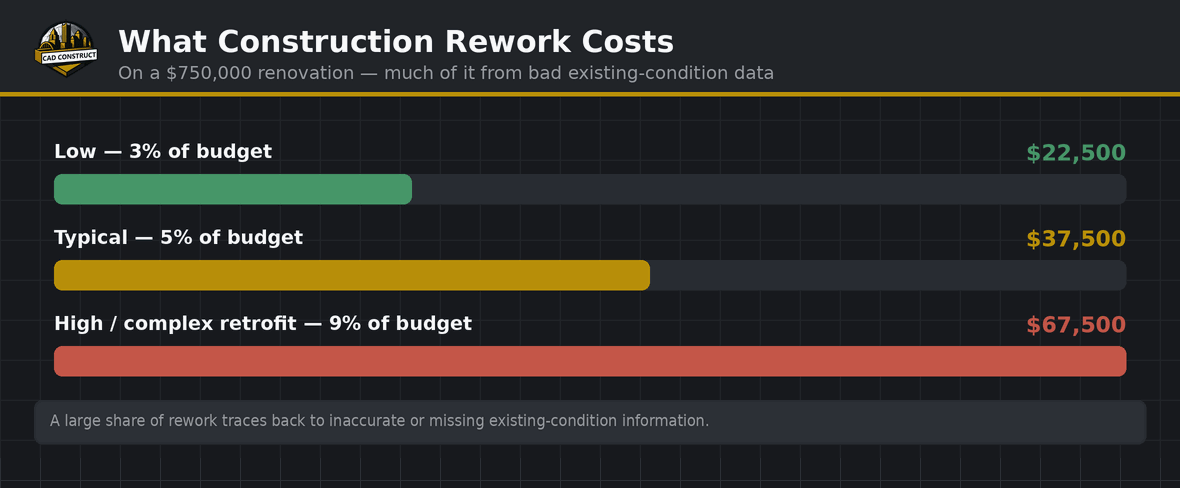
The most visible cost is rework. When as-built drawings are wrong or field measurements miss something, the error surfaces during construction — a duct that will not fit, a steel member that is an inch off, a wall that is not where the drawing says. Fixing it means change orders, delays, and crews standing around. A single significant change order can cost more than the entire scan that would have prevented it.
Wasted material and prefabrication failures
Prefabrication saves money only when the measurements are right. Components fabricated off-site from inaccurate data do not fit when they arrive, turning a cost-saving strategy into an expensive mistake. Accurate scan data is what makes prefabrication pay off.
Repeated site visits
Without a complete scan, teams return to the building again and again to check a dimension, verify a condition, or capture something they missed. Each trip costs time and money, and each one is an opportunity to introduce another measurement error. A scan captures everything once, so the answer to almost any later question is already in the data.

Quantifying the return
While every project is different, the pattern is consistent: the cost of scanning is small relative to the cost of the errors it prevents. On renovation and retrofit work, existing-conditions surprises are routinely among the biggest sources of budget overrun, and even eliminating one or two of them typically covers the scan several times over. When you factor in schedule savings — finishing sooner because the work was not stopped by field conflicts — the return grows further, because time on a construction project is money in financing, labor, and lost use of the building.
There is also a value that is harder to put a number on but very real: predictability. A project that starts from accurate data behaves more predictably, which protects both the budget and the relationships between owner, designer, and contractor. Fewer surprises means fewer disputes.

Projects where scanning pays off most
Laser scanning delivers a return on almost any existing-building project, but the ROI is highest in a few situations.
- Renovations and retrofits, where the gap between old drawings and current reality is the primary risk to the budget.
- MEP-intensive work, where dense mechanical, electrical, and plumbing systems must be coordinated in tight spaces and clashes are costly.
- Prefabrication and modular construction, where components must fit the first time.
- Historic and complex structures, where irregular geometry defies manual measurement.
- Facility management and space planning, where an accurate model pays back across years of operations.
In each of these, the cost of getting existing conditions wrong is high, and that is exactly where accurate capture returns the most.

The scan as a reusable asset
One of the most underappreciated aspects of scanning ROI is that a scan is not a single-use expense — it is a durable asset. The same capture that supports today’s renovation can support tomorrow’s tenant fit-out, next year’s equipment install, and long-term facility management. Because the data documents the entire building, it answers questions that have not even been asked yet, without sending a crew back to the site. Spreading the cost of one capture across many future uses dramatically improves the return.
For owners of multiple properties, this compounds. A portfolio documented with accurate scan data becomes a strategic resource, shortening the front end of every future project and giving every design team they hire a reliable starting point.
How to think about the decision for your building
The right way to evaluate scanning is not to ask whether it is cheaper than a tape measure — it is not, and it is not meant to be. The right question is whether the certainty it provides is worth more than it costs, given what is at stake on your project. For a small, simple space with forgiving tolerances and no complex systems, manual measurement may be adequate. For anything involving significant investment, tight coordination, an occupied building, or an unforgiving schedule, the math almost always favors scanning.
A useful test is to ask what a single serious existing-conditions surprise would cost you in change orders, delay, and disruption. If that number is larger than the cost of a scan — and on most substantial projects it is — then scanning is not an expense, it is risk reduction that pays for itself.

A simple worked example
Imagine an owner renovating a mid-sized commercial building. The existing drawings are twenty years old and have been marked up through several prior tenant changes. The team has two choices: trust the drawings and field-verify with tape measures, or commission a laser scan of the building up front. Choosing the tape measure feels cheaper on day one. But midway through construction, the crew discovers that a structural bay is positioned differently than the drawings show, forcing a redesign of the mechanical routing, a change order, and a two-week delay while new ductwork is fabricated. The cost of that single surprise — design time, fabrication, delay, and disruption — dwarfs what a scan would have cost at the outset.
Now run the same project with a scan. The discrepancy is visible in the point cloud before design is finalized, the mechanical routing is designed correctly the first time, and the ductwork is prefabricated to fit. There is no change order, no delay, and no dispute over who is responsible. The scan did not just pay for itself; it protected the schedule, the budget, and the working relationship between everyone on the project. That is the ROI of certainty, and it is why experienced teams increasingly treat scanning as a default first step rather than an optional extra.

Common questions about laser scanning ROI
Isn’t scanning only worth it for large projects?
Large and complex projects show the clearest return, but many smaller projects benefit too, especially when systems are tight or tolerances are unforgiving. The deciding factor is risk and complexity, not size alone.
How quickly does the investment pay off?
Often immediately, on the very first project, by preventing a change order or avoiding repeated site visits. The payback accelerates every time the data is reused for a later need.
What if my project ends up not needing all the data?
Capturing the whole building is inexpensive insurance. Data you did not end up needing costs little; data you needed but did not capture can be very expensive to go back for.
3D laser scanning is worth it when the certainty it provides is worth more than it costs — which, on most existing-building projects, it clearly is. By preventing errors, protecting schedules, and serving as a reusable record, a single scan returns its value many times over.

Related guides
Free tools & templates
- 3D laser scanning cost calculator
- As-built documentation cost calculator
- Scan-to-BIM cost calculator
- 360° virtual tour cost calculator
- Virtual storefront cost calculator
- As-built ROI & rework-cost calculator
- Scan-to-BIM RFP template (Word)
- As-built scope-of-work template (Word)
- Site-prep checklist (Word)
Planning a project in the Pittsburgh region? CAD Construct LLC delivers 3D laser scanning, Scan-to-BIM, and virtual tours with field-verified accuracy. Request a scanning quote.

Weighing the return for your project
The ROI of 3D laser scanning ultimately depends on what a field conflict would cost you. On projects where inaccurate existing conditions lead to rework, change orders, or delays, the upfront investment in accurate capture typically pays for itself many times over. Weighing that cost of certainty against the cost of surprises is the clearest way to judge whether scanning is worth it for your project.


0 Comments