Last updated:
Where an unclear scope meets the field: the mistakes a defined RFP avoids
Key takeaways:
- Define deliverables, accuracy, and formats before scanning.
- Ensure full coverage and proper registration overlap.
- Confirm the coordinate system and prep the site in advance.
3D laser scanning is a powerful tool, but like any technology, its value depends on doing it right. Owners and project teams new to reality capture sometimes make avoidable mistakes that lead to incomplete data, blown budgets, or deliverables that do not fit their needs. Learning the common pitfalls in advance helps you commission a scan that delivers exactly what your project requires. This guide covers the most common 3D laser scanning mistakes and how to avoid them.
Whether it is your first scanning project or you simply want to get more from the process, understanding these pitfalls will help you plan better and get better results.
Mistake 1: Not defining the deliverable clearly
The most common and costly mistake is failing to define clearly what you actually need from the scan. A point cloud, 2D drawings, a BIM model, a virtual tour — these are very different deliverables with different costs and uses. When the deliverable is left vague, owners often receive something that does not fit their project, or pay for detail they do not need. Before commissioning a scan, be specific about what you need, in what format, and at what level of detail, and put it in writing. This single step prevents a whole category of disappointment and wasted spend.
Defining the deliverable also means thinking about how you will use the data. Discussing your goals with the provider lets them recommend the right deliverable and level of detail, ensuring the scan serves your actual purpose rather than producing data that sits unused.
Mistake 2: Scanning too little of the building
Another frequent mistake is capturing only part of a building to save money, then discovering later that an un-scanned area was needed. Returning for a second capture costs more than including the area the first time, and sometimes the opportunity is gone entirely. Because the incremental cost of capturing an entire building during a single visit is relatively low, it is usually wise to scan comprehensively, even if you only model or use part of it now. Complete capture is inexpensive insurance against the expensive problem of missing data.
Mistake 3: Choosing a provider on price alone
Selecting a scanning provider based solely on the lowest price is a common error that often costs more in the end. An unusually cheap scan may mean rushed capture, loose registration, incomplete coverage, or thin deliverables that need expensive correction. Accuracy, reliability, format compatibility, and relevant experience matter more than price alone. The cheapest scan that produces unreliable or unusable data is the most expensive option once you account for the rework it causes. Evaluate providers on their process, accuracy verification, and understanding of your project, not just their quote.

Mistake 4: Not verifying accuracy and format compatibility
Some owners assume all scan data is equally accurate and usable, only to find the data does not meet their needs or does not open in their software. Before hiring, confirm the accuracy the provider expects to deliver and how they verify it, and make sure they will deliver in a format your team can actually use. A beautiful point cloud in the wrong format, or data whose accuracy cannot be demonstrated, undermines the whole purpose of scanning. Verifying these details up front prevents a frustrating and avoidable problem at delivery.
Mistake 5: Poor preparation and access
Inadequate preparation causes incomplete scans and inefficient captures. When the crew cannot access certain areas, those areas become gaps in the data. When priorities are not communicated, important details may be missed. When safety requirements are not handled in advance, the capture is delayed. Preparing properly — providing access to every area, clearing clutter, communicating priorities and safety needs, and sharing what you know about the building — ensures a complete, efficient capture. This simple preparation is one of the easiest ways to avoid disappointing results.
Mistake 6: Not planning for the data’s future use
Finally, many owners treat a scan as a one-time deliverable rather than a lasting asset, and fail to keep the underlying data. The point cloud is a valuable record that can support future projects, produce additional deliverables, and answer questions for years. Discarding it, or not requesting it, means having to re-scan for future needs. Keeping the point cloud and thinking of the scan as a reusable asset maximizes its value over time and avoids the cost of capturing the same building twice.

Common questions about avoiding scanning mistakes
What is the single most important thing to get right?
Defining the deliverable clearly. Knowing exactly what you need, in what format and detail, prevents the most common and costly problems and ensures the scan serves your actual project.
Should I always scan the whole building?
Usually yes. The incremental cost of capturing everything in one visit is low compared to the cost of returning for missed areas. Complete capture is inexpensive insurance.
How do I avoid choosing the wrong provider?
Evaluate providers on process, accuracy verification, format compatibility, and relevant experience, not just price. Ask how they verify accuracy and what exactly you will receive.
Most 3D laser scanning mistakes come down to unclear scope, incomplete capture, and choosing on price alone. Defining your deliverable, scanning comprehensively, verifying accuracy and format, preparing well, and keeping the data will help you avoid the common pitfalls and get a scan that truly serves your project.
Mistake 7: Rushing the planning stage
Many scanning problems trace back to insufficient planning before the crew ever arrives. Rushing to schedule a scan without clarifying the scope, the deliverables, the access, and the priorities almost guarantees a less useful result. Good scanning projects begin with a planning conversation that aligns everyone on what the scan needs to accomplish and how it will be captured. Skipping this step to save time is a false economy, because the confusion and gaps it creates cost far more time later. Investing a little effort in planning up front is one of the most reliable ways to ensure a smooth capture and a deliverable that fits.
Planning also includes realistic scheduling. Coordinating access, occupancy, and any safety requirements in advance lets the capture proceed efficiently on the day, rather than stalling while issues are resolved on the fly. A well-planned scan is a fast, complete scan.

How to plan a successful scanning project
Avoiding these mistakes comes down to a straightforward approach. Start by defining clearly what you need — the deliverable, format, and level of detail — and put it in writing. Choose a provider based on process, accuracy, and experience, not just price, and confirm they can deliver in your required format. Plan to capture the whole building rather than risk missing areas. Prepare properly by arranging access and communicating priorities. And keep the point cloud as a lasting asset. Following this approach turns scanning from a source of potential frustration into a reliable process that delivers exactly what your project needs.
Above all, treat the provider as a partner and communicate openly about your goals. A knowledgeable firm will help you avoid these pitfalls, recommend the right approach, and ensure the scan serves your project — which is why choosing the right partner and communicating well is the foundation of a successful scanning project.
The cost of getting it wrong
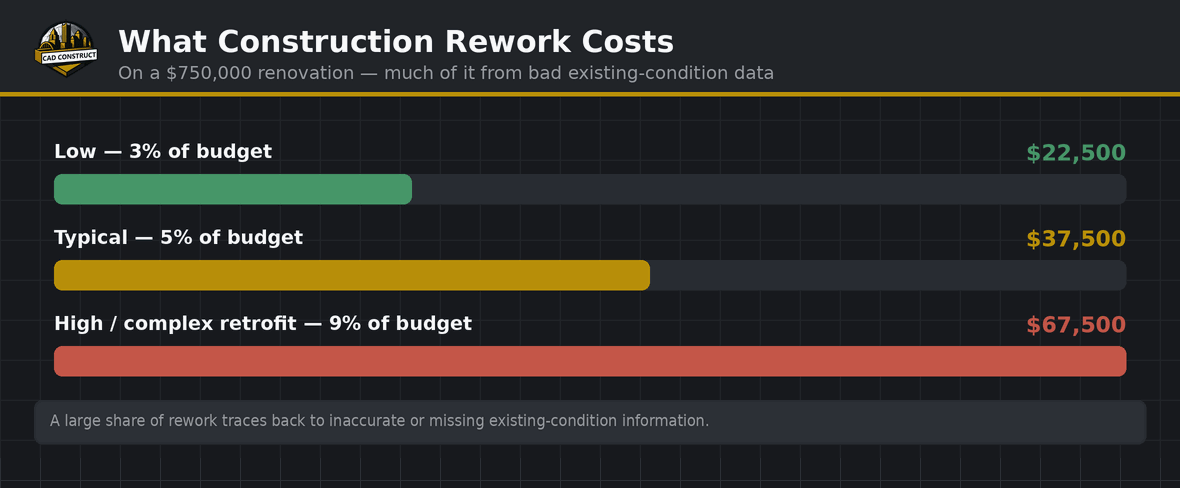
It is worth understanding what these mistakes actually cost, because the numbers make the case for doing scanning right. An unclear deliverable can mean paying for a model you cannot use or drawings that miss what you needed. Incomplete capture can force a return visit at full mobilization cost, or worse, leave a gap that surfaces as a construction surprise. Choosing a provider on price alone can yield data so unreliable it must be recaptured entirely. In every case, the mistake costs far more than doing it correctly the first time would have. Scanning is fundamentally about buying certainty and accuracy; mistakes that undermine that certainty defeat the entire purpose and waste the investment.
The encouraging news is that all of these mistakes are avoidable with a little foresight. None require special expertise on your part — only clear thinking about what you need, a careful choice of provider, and good communication. A provider worth hiring will actively help you avoid these pitfalls, because delivering data you can actually use is how they earn repeat business and referrals. Approaching the project as a collaboration, with clear goals and open communication, is the surest way to get scanning right and avoid the common errors that trip up first-time buyers.
How can I be sure I am avoiding these mistakes?
The simplest safeguard is to work with an experienced provider and communicate clearly from the start. Define your deliverables in writing, ask how accuracy is verified and in what format you will receive the data, plan to capture the whole building, prepare access in advance, and request the point cloud as a lasting record. A provider who welcomes these questions and helps you plan is one who will help you sidestep the common pitfalls and deliver a scan that genuinely serves your project.
Related guides
Planning a project in the Pittsburgh region? CAD Construct LLC delivers 3D laser scanning, Scan-to-BIM, and virtual tours with field-verified accuracy. Request a scanning quote.


0 Comments