Reaching hazardous and high areas from a safe distance
Is 3D laser scanning safe on a job site?
Quick answer: Yes. Scanners measure from a distance without touching anything, so nobody has to climb ladders, enter confined spaces or stand near hazards to take dimensions. The scanners use eye-safe lasers and add little risk themselves, and site safety rules still apply to everyone on site, including whoever operates the scanner.
Key takeaways:
- Non-contact capture reaches elevated, restricted and hazardous areas from a safe position.
- Less time in the field means less exposure to site hazards.
- Construction laser use is covered by OSHA 1926.54; site-specific rules apply as well.
Why scanning is a safety tool, not just a data tool
Laser scanning is usually described in terms of accuracy and efficiency, but one of its most underrated benefits is safety. Capturing a site with a scanner keeps people out of hazardous positions that traditional measurement would put them in, and it produces a record that supports safer planning throughout a project. On active job sites — where hazards are constant and conditions change daily — the ability to gather complete, accurate data from a safe distance is a genuine advantage for worker protection, not merely a convenience for the design team.
Understanding how scanning improves safety helps site managers and safety professionals see it as part of their toolkit rather than just a surveying service.
Measuring without entering the danger zone
The most direct safety benefit is that a scanner captures far more than a person could reach, from a safe vantage point. Instead of climbing to measure a high steel connection, leaning over an edge to dimension a parapet, or reaching into a live mechanical space, a technician sets the scanner where it is safe and lets the laser reach the hazard. Heights, confined areas, and busy zones can all be documented without placing a worker in the risky spot. The measurement travels to the danger so the person does not have to.
Less time exposed to hazards
Beyond avoiding specific dangerous positions, scanning simply reduces the total time people spend exposed to site hazards. A capture that would take hours of manual measurement — each minute of it spent amid traffic, machinery, or unstable conditions — is compressed into a fraction of the time with a scanner. Fewer person-hours on a hazardous site means fewer opportunities for something to go wrong. This reduction in exposure is a quiet but meaningful contribution to a site’s overall safety performance.

Documenting hazardous and unstable structures
Some structures are dangerous precisely because they need to be documented — fire-damaged buildings, partial collapses, deteriorating structures, and failure sites. Sending people into these to take measurements is exactly what safety practice tries to avoid. A scanner captures them accurately from outside or from a safe standoff, giving engineers the geometry they need to assess the structure without anyone entering an unstable environment. The data comes back complete, and no one had to risk entering a compromised space to get it.
Capturing confined and restricted spaces
Confined spaces carry serious hazards and strict entry procedures for good reason. While scanning does not eliminate every need to enter such spaces, it can dramatically reduce entries by capturing thorough data in a single, brief visit rather than requiring repeated trips to re-measure. In some configurations, a scanner can reach into a space that a person would otherwise have to enter, gathering the geometry from the threshold. Every avoided or shortened confined-space entry is a reduction in one of the most dangerous activities on a site.
Safer planning and coordination
The safety benefit does not end when the scan does. An accurate model of existing conditions lets teams plan work more safely before anyone lifts a tool. Access routes, equipment placement, lift positions, and sequencing can all be studied against measured reality, so hazards are anticipated and designed out rather than discovered in the field. Coordinating trades against an accurate model also reduces the chaotic, last-minute changes that so often create unsafe conditions on site. Better information up front means fewer dangerous surprises later.
Reducing rework that creates risk
Rework is not just costly; it is dangerous. Every time a mistake sends crews back to demolish, re-cut, or reinstall, it creates fresh exposure to hazards that a right-first-time approach would have avoided. Because scanning produces accurate existing conditions that prevent errors and conflicts, it cuts down on the rework that generates so much unnecessary risk. Fewer do-overs mean fewer hours spent in hazardous activity, which is a safety benefit that compounds across the life of a project.

Supporting emergency and incident response
When something goes wrong on a site, rapid and accurate documentation supports both the response and the investigation. A scanner can capture an incident scene quickly and from a safe distance, preserving conditions for analysis without putting investigators at risk in a compromised area. That same speed helps get a site back to safe operation sooner, because decisions can be made from complete data rather than from cautious, time-consuming manual inspection of a hazardous area.
Scanning equipment is itself safe to use
The scanners themselves introduce essentially no new hazards. They use eye-safe lasers, run on their own power, and involve no heavy or dangerous machinery. A technician operating a scanner adds a low-risk activity to a site rather than a new danger, and the equipment integrates easily into existing site-safety protocols. This means the safety benefits come without an offsetting cost — the tool that keeps people out of harm’s way is itself among the safest pieces of equipment on the site.
How CAD Construct prioritizes safety
CAD Construct treats safety as part of good scanning practice, capturing sites in ways that minimize exposure for everyone involved and delivering data that supports safer planning downstream. For contractors and owners across the Pittsburgh region, that means existing-conditions capture that protects workers on the day of the scan and helps prevent the errors, rework, and hazards that put people at risk later in the project.
Keeping traffic and crews separated
On busy sites, one of the persistent dangers is the overlap of people, equipment, and vehicles in the same space. Because scanning captures a complete site quickly, it reduces the need for surveyors and measurement crews to work in active traffic zones for extended periods. A single technician with a scanner spends far less time in the flow of forklifts, cranes, and deliveries than a manual survey team would. Fewer people lingering in high-traffic areas means fewer chances for the kind of struck-by incident that ranks among the most common serious hazards on a job site.
Verifying safety-critical dimensions
Some measurements exist specifically to keep people safe — guardrail heights, clearances, egress widths, stair geometry, and the like. Capturing these with a scanner produces objective, accurate records that confirm safety-critical conditions meet requirements. If a question arises later about whether a clearance was adequate or a rail was tall enough, the measured data answers it definitively. This makes scanning a useful tool not only for avoiding hazards during capture but for documenting that a finished environment is genuinely safe to occupy and use.

A record that supports safety compliance
Accurate site documentation also supports the paperwork side of safety. A measured record of conditions at a point in time can substantiate that a site met its requirements, support inspections, and provide evidence if conditions are ever questioned. Rather than relying on memory or sparse notes, safety managers can point to a complete, dated capture of the site. This objective record strengthens a safety program and provides protection for everyone involved if a dispute or investigation ever looks back at how the site was configured.
Training and hazard awareness
An accurate three-dimensional capture of a site can also serve as a training and briefing tool. Crews can walk through conditions virtually before setting foot on site, identifying hazards, planning safe routes, and understanding a complex environment in advance. This kind of preparation helps workers arrive already aware of where the dangers are, rather than discovering them in real time. Using scan data to brief teams turns the capture into an ongoing safety asset that improves awareness well beyond the moment it was collected.
Safety and efficiency go together
The encouraging reality is that scanning’s safety benefits and its efficiency benefits reinforce each other. The same qualities that make it fast and accurate — remote capture, rapid data collection, complete coverage — are exactly what keep people out of harm’s way. There is no trade-off between doing the job well and doing it safely; scanning advances both at once. For a site manager weighing how to gather existing conditions, that alignment makes laser scanning an easy choice on safety grounds alone, before its data value is even considered.
Building safety into every capture
Ultimately, safe scanning comes down to planning and experience. A crew that understands site hazards, follows established protocols, and positions its captures thoughtfully protects both its own people and everyone else on site. The equipment makes remote, rapid capture possible, but it is disciplined practice that turns that capability into a genuine safety advantage. When existing-conditions capture is approached with safety as a priority rather than an afterthought, the result is a project that starts on the right foot — accurate data in hand and no one having been put at unnecessary risk to collect it.
Related reading
Construction Document Packages: What Should Be Included?
Drafter vs Architect vs Designer (2026 Guide for Homeowners)
The Role of AI in Architecture and Engineering
3D Laser Scanning for Power Plants & Substations · Laser Scanning for Structural & Deformation Monitoring
FAQ
Is scanning safer than hand measuring? Generally, yes. A scanner captures high, restricted or hazardous areas from a safe position, so nobody has to climb ladders or reach into confined spaces with a tape. It also reduces return trips, which means less total time exposed to site hazards.
Do you follow site safety rules? Yes, including OSHA and site-specific requirements. Before field day we confirm safety orientation, PPE, escorts, permit-to-work requirements and allowed hours, then plan scan positions to match. Send us your site rules with the scope so they can be included in the plan.
Are laser scanners safe for people nearby? The scanners used for building documentation use eye-safe lasers and involve no heavy machinery, so people can usually keep working around them. The main practical risks are ordinary ones, such as tripod placement in walkways and traffic, which are handled by planning the setups.
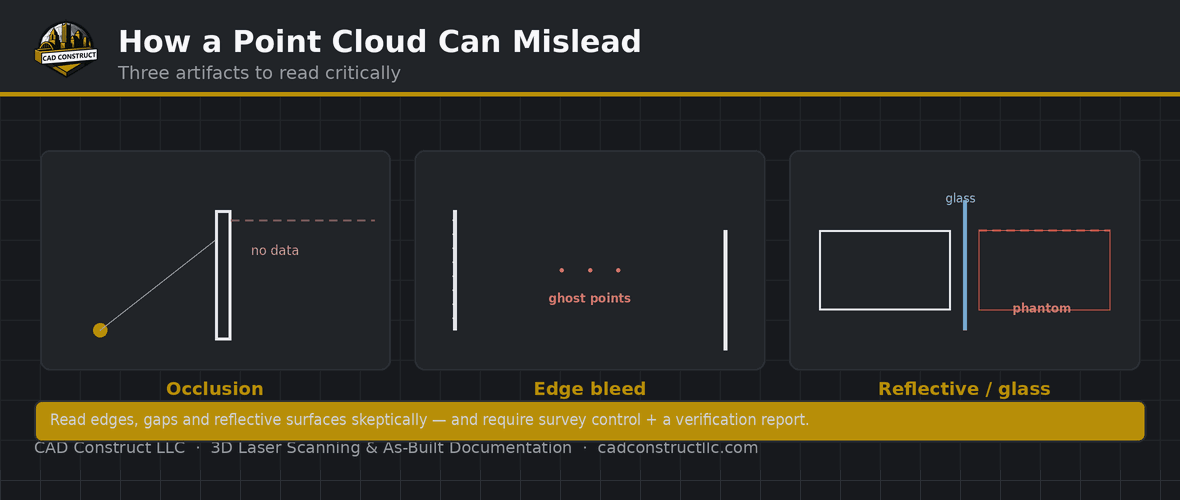
Can you scan an active construction site? Yes, with planning. We coordinate timing and access with the site team, avoid active lifts and hazardous work zones, and choose scan positions away from traffic. Moving crews and equipment can leave gaps, so we capture restricted areas when they are clear.
Get field-verified existing conditions in Pittsburgh
CAD Construct LLC delivers 3D laser scanning, as-built drawings, scan-to-BIM, and 360° virtual tours across Pittsburgh & Western PA. Request a free quote or call (800) 967-2627.


0 Comments