
Short answer: Registration is the process of aligning dozens or hundreds of individual scan setups into one coordinate system. Small alignment errors compound as they chain across a building, so a cheap scan can look flawless up close and be off by centimeters at the far end. Survey control, good targets, and a verification report are what keep registration error from becoming a field problem.
Every laser scan you’ve ever seen is actually many scans. A scanner captures one position, moves, captures another, and repeats — dozens of setups for a floor, hundreds for a building. Registration is how those setups get stitched together into a single, seamless point cloud. It’s also where the cheapest scans quietly go wrong.
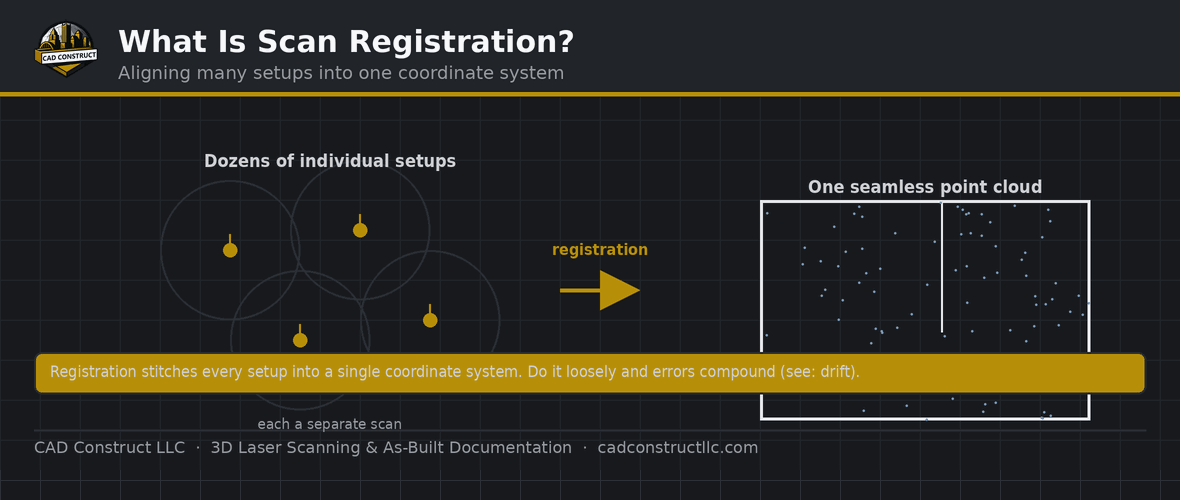
Why registration error compounds
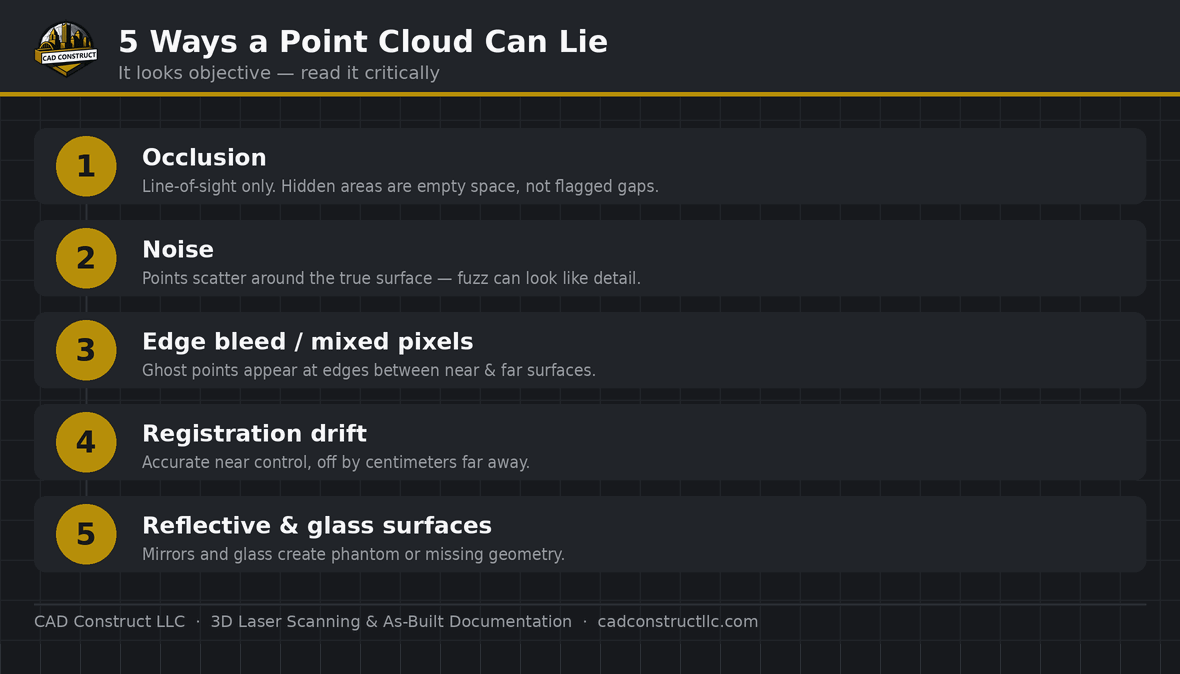
Each time two scans are aligned, there’s a tiny residual error. Align them well and it’s a fraction of a millimeter. Align them loosely — few overlaps, no control, cloud-to-cloud only — and each hand-off adds a little more. Because setups chain across a building, those errors accumulate. The result is “drift”: the model is dead-on near the starting point and progressively wrong as you move away from it. On a single room you’d never notice. Across a 200-foot floor or a five-story stair, drift can exceed your entire accuracy tolerance.
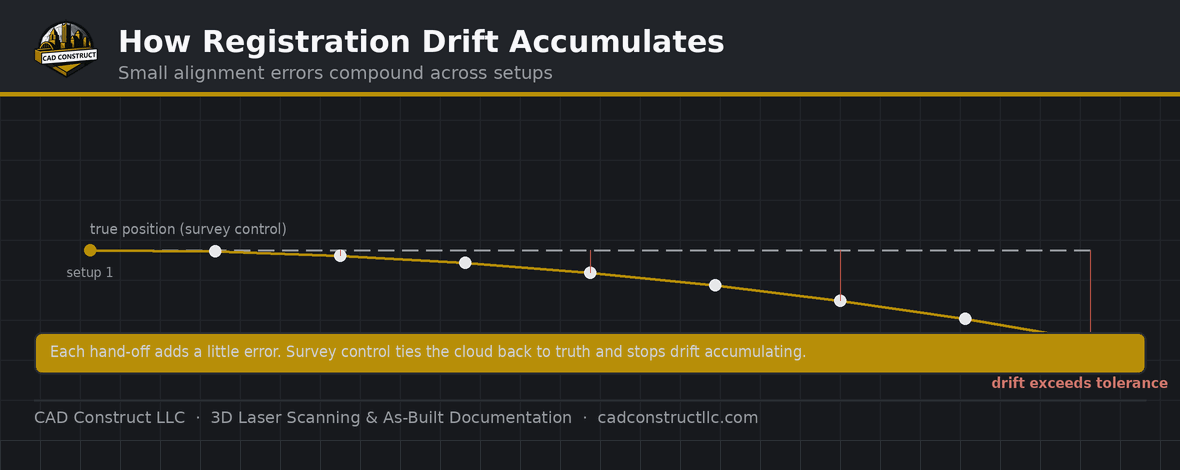
How cheap scans hide it
Registration error is invisible in the deliverable everyone looks at. Pan around a poorly registered cloud and it still looks crisp and complete — the surfaces are smooth, the walls are straight. The error isn’t in how any single scan looks; it’s in where each one sits relative to the others. Without an independent check, nothing on screen reveals it. That’s exactly why a low bid can look identical to a rigorous one right up until someone measures against the real building.
What it actually costs
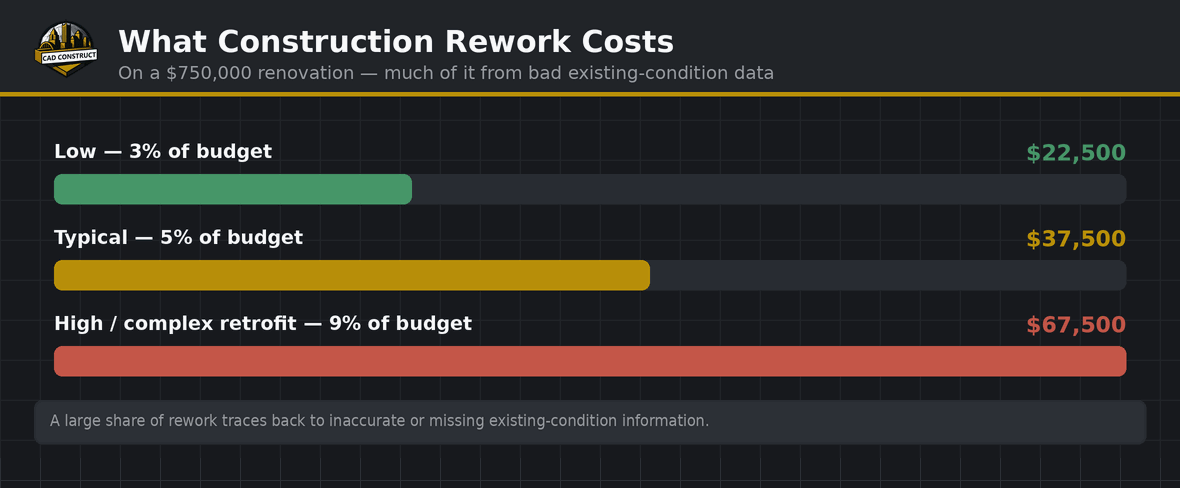
Drift doesn’t stay in the computer. Steel fabricated to a drifted model arrives the wrong length. A duct run modeled through “clear” space hits a beam that was really six centimeters over. A tenant fit-out that looked coordinated needs field rework because the far wall wasn’t where the model said. The scan was the cheap part; the rework, the schedule slip, and the change orders are where a “bargain” scan gets expensive.
How registration is done right
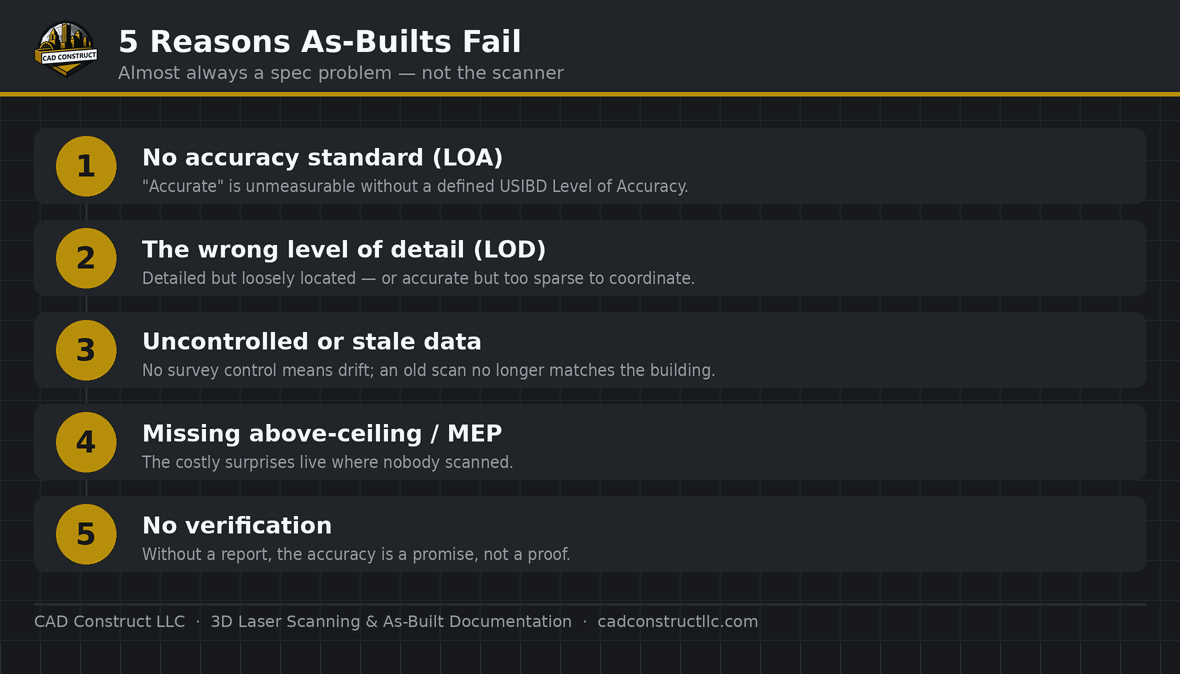
Rigorous registration rests on three things: survey control (a network of known points that ties the cloud to real-world coordinates and stops drift from accumulating), good overlap and targets (enough shared geometry or targets between setups for tight alignment), and a verification report (independent checks proving achieved accuracy at 95% confidence). On large or multi-story work, control isn’t optional — it’s the difference between a model that holds together end-to-end and one that slowly walks away from reality.
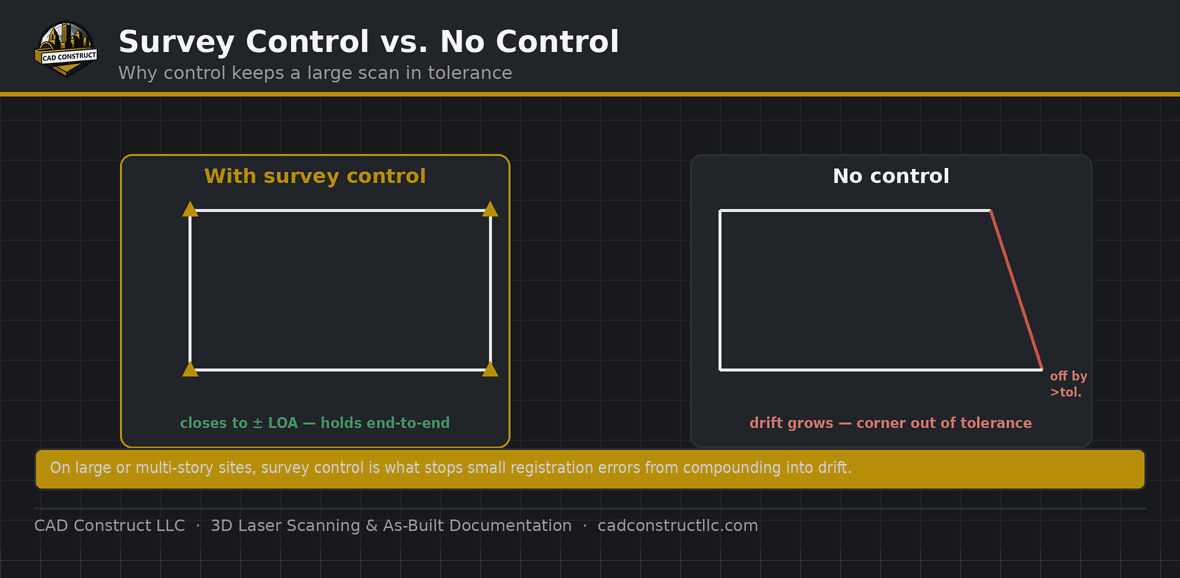
How to protect your project
You don’t have to audit point clouds yourself. Put three requirements in the scope: survey control for anything large or multi-story, a stated USIBD Level of Accuracy (LOA), and a field-verification report. Those three lines make registration quality contractual instead of hopeful — and make competing bids comparable on something real. Our 3D laser scanning and scan-to-BIM deliverables are control-based and verified by default.
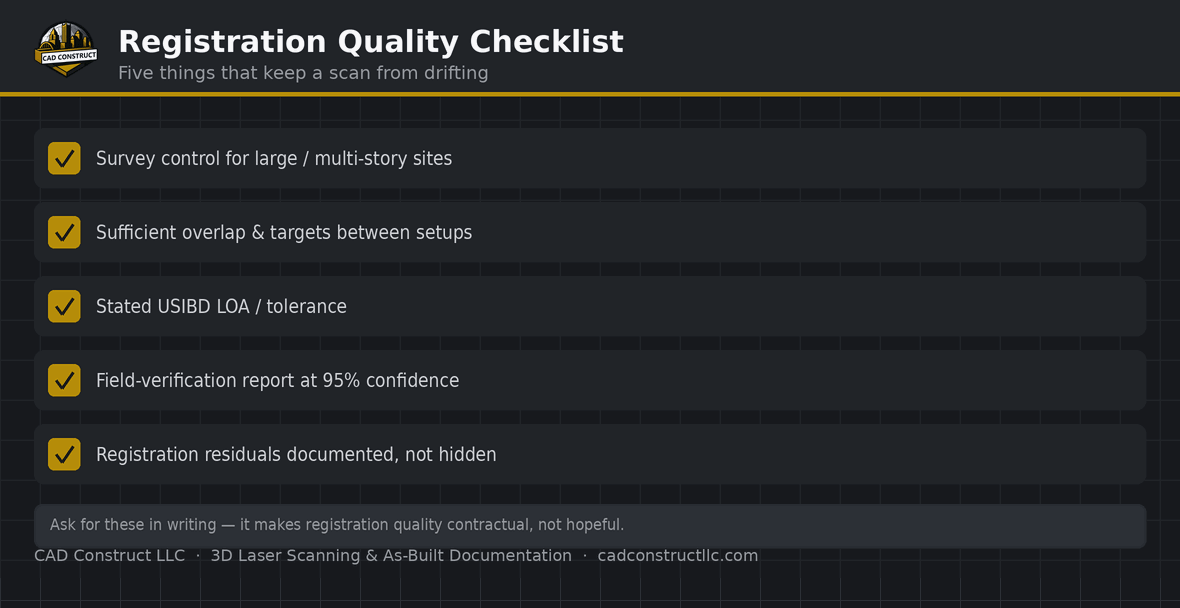
Frequently asked questions
What is scan registration in plain terms?
It’s aligning all the individual scanner setups into one shared coordinate system so they form a single, seamless point cloud.
Why does registration error grow across a building?
Setups chain together, and each alignment adds a small residual error. Those errors accumulate the farther you get from the control, producing “drift.”
Can I see registration error in the point cloud?
Usually not by eye — the surfaces still look clean. It shows up only when you compare the cloud to independent measurements.
Does every project need survey control?
Small single spaces often don’t. Large footprints and multi-story buildings do — control is what stops drift.
How do I verify registration quality?
Require a verification report: achieved accuracy versus independent checks at 95% confidence.
Related resources
Want control-based, verified scanning? Request a quote.

CAD Construct LLC
3D laser scanning, as-built documentation, scan-to-BIM & 360° virtual tours across Pittsburgh & Western PA — 20+ years turning existing buildings into field-verified digital records. cadconstructllc.com


0 Comments