Last updated:
Carrying billions of points down to a file your software can open
How decimation and noise filtering make massive point clouds manageable without losing the accuracy you need.
Cleaning and right-sizing data
Raw scans contain noise and billions of points. Filtering removes stray points; decimation reduces density to a workable size while preserving the detail your deliverable needs.
Why it matters
Clean, right-sized clouds open faster in Revit and AutoCAD and are easier to share.
Making massive point clouds usable
A raw laser scan captures an astonishing amount of data — often hundreds of millions or even billions of points. That density is a strength, but it also makes raw clouds unwieldy: slow to open, hard to share, and heavy to work with. Decimation and noise filtering are the processing steps that turn that overwhelming raw data into a clean, efficient, usable point cloud. Decimation reduces the number of points intelligently, while noise filtering removes the stray, erroneous points that every scan inevitably collects. Together they make the difference between data that is merely captured and data that is genuinely workable.
Understanding these steps helps clients appreciate why processing is as important as the scan itself.
What decimation does
Decimation reduces the point count of a cloud while preserving its essential shape and detail. A raw scan often contains far more points than a given task requires — points so densely packed that removing a portion of them changes nothing about the usable geometry. Decimation thins the cloud thoughtfully, keeping enough points to represent surfaces accurately while discarding the redundant excess. The result is a lighter dataset that behaves far better in software, opens faster, and shares more easily, without meaningfully sacrificing the detail the project depends on.
Why less can be more
It may seem counterintuitive to throw away data, but for most uses a decimated cloud is more valuable than the raw one. A cloud so heavy that it crashes software or takes minutes to load is difficult to use, no matter how detailed. By reducing the point count to what a task actually needs, decimation makes the data responsive and practical. The key is matching the level of decimation to the purpose — keeping high density where fine detail matters and thinning more aggressively where it does not — so the cloud is efficient without losing anything important.

What noise filtering removes
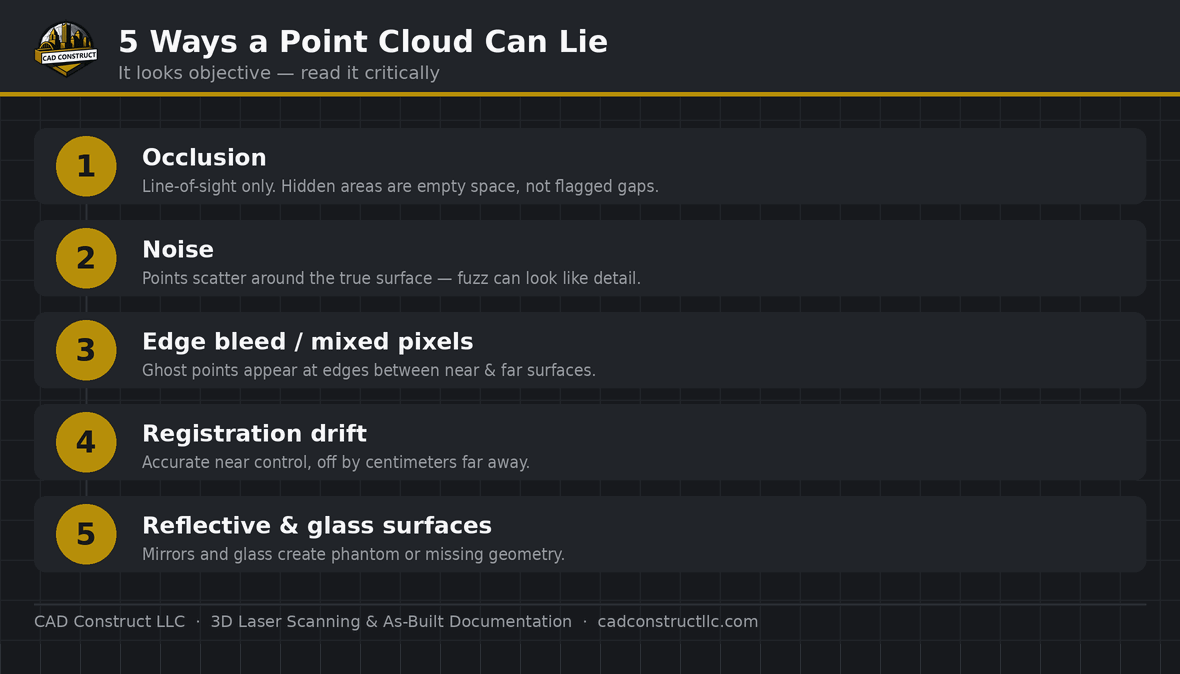
Every scan collects some points that do not represent real surfaces. Reflective materials, moving objects, dust, edges, and the physics of the laser itself all produce stray points — noise — floating in space where nothing actually exists. Noise filtering identifies and removes these erroneous points, cleaning up the cloud so that what remains faithfully represents the real environment. Without filtering, the noise clutters the data, confuses measurements, and makes the cloud look messy; with it, the cloud reads cleanly and can be trusted to reflect reality.
Common sources of noise
Understanding where noise comes from helps explain why filtering is necessary. Shiny and reflective surfaces bounce the laser in unpredictable ways, generating phantom points. Glass may be partly penetrated, producing points behind it. People, vehicles, and equipment moving through a scan leave transient traces. The edges of objects create scattered returns as the beam catches them obliquely. Each scan encounters its own mix of these effects, and skilled filtering addresses them appropriately, distinguishing the genuine surface points from the artifacts that should be cleared away.
Balancing cleanup against detail
Noise filtering demands judgment, because filtering too aggressively can remove real detail along with the noise. Fine features, thin objects, and subtle surfaces can resemble noise to an automated filter, so careless cleanup risks erasing legitimate data. The goal is to remove the artifacts while preserving everything real, which requires balancing the strength of the filtering against the need to keep genuine detail. An experienced processor tunes this balance carefully, producing a cloud that is clean without being stripped of the information that makes it valuable.
Tailoring processing to the deliverable
How much a cloud should be decimated and filtered depends entirely on what it is for. A cloud destined for detailed modeling of fine features needs to retain high density and careful detail, while one intended for general documentation or visualization can be thinned more aggressively. Processing is therefore not a one-size-fits-all step but one tailored to the deliverable, ensuring the final cloud is optimized for its intended use. Matching the processing to the purpose delivers data that is both efficient and fit for the job it needs to do.

The payoff of clean, efficient data
Well-processed point clouds are simply better to work with. They open quickly, run smoothly, measure reliably, and share without difficulty, and they present a clean picture that inspires confidence rather than a cluttered one that raises doubts. The effort invested in decimation and filtering pays back every time the data is used, turning an overwhelming raw capture into a practical tool. This is why processing is an essential part of scanning rather than an optional extra — it is what makes the captured reality genuinely usable.
How CAD Construct processes scan data
CAD Construct processes every capture with careful decimation and noise filtering, delivering point clouds that are clean, efficient, and tailored to how the data will be used. For clients across the Pittsburgh region, that means scan data that is not just accurate but genuinely workable — optimized for modeling, documentation, or analysis, and free of the clutter and bulk that make raw data so difficult to handle.
Registration and its effect on quality
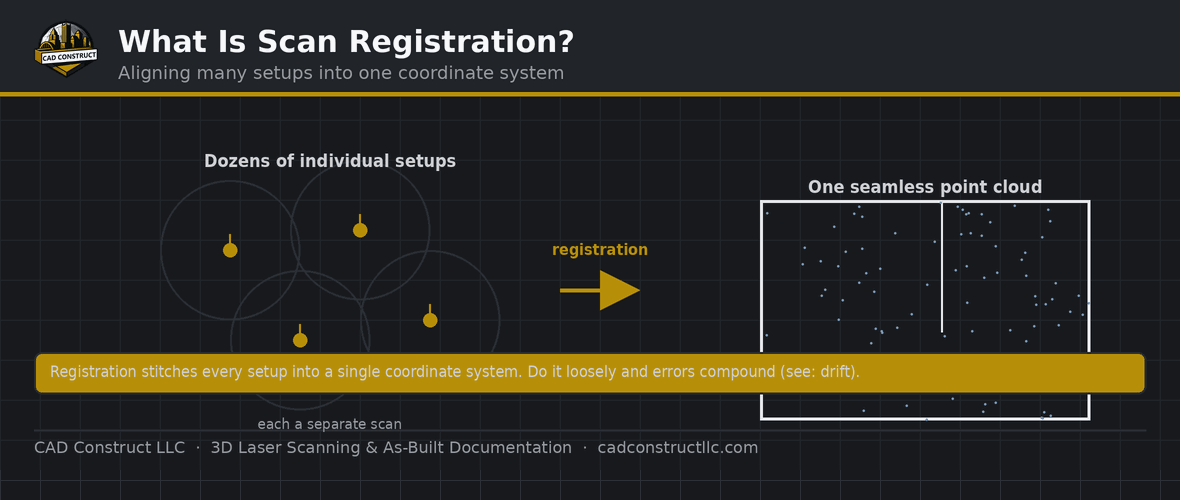
Before decimation and filtering, the individual scans must be registered — aligned together into one unified cloud. The quality of that registration directly affects how clean the final data can be, because misaligned scans create doubled surfaces and apparent noise where two captures of the same wall fail to line up. Good registration is therefore the foundation on which effective processing rests. When scans are aligned precisely, filtering and decimation can focus on genuine artifacts rather than fighting the blur of poor alignment, and the resulting cloud is both accurate and clean.
Automated tools and human oversight
Modern processing software offers powerful automated tools for decimation and noise removal, but the best results still depend on human judgment. Automated filters handle the bulk of the work efficiently, yet they cannot always distinguish a delicate real feature from an artifact, or know how much detail a particular project needs to keep. Skilled oversight guides the automation, reviewing results and adjusting the approach where the software would otherwise err. This combination of efficient automation and experienced judgment produces cleaner, more reliable data than either could achieve alone.
Preserving accuracy through processing
A central concern throughout processing is that the cloud must remain accurate. Decimation and filtering change which points are present, but they should never distort the geometry that remains. Done correctly, these steps remove redundancy and error while leaving the true measurements untouched, so the processed cloud is every bit as accurate as the raw one — just cleaner and lighter. Maintaining that accuracy is the whole point: the processing exists to make accurate data usable, not to trade away precision for convenience. Verifying the processed cloud against the source protects that accuracy.

Formats and delivery
Once a cloud is decimated and filtered, it is prepared in the formats the project requires, whether for a modeling platform, a CAD environment, or a viewer for stakeholders. Different tools prefer different formats and densities, so part of processing is delivering the data in a form that drops smoothly into the client’s workflow. A cloud that is clean and efficient but delivered in an awkward format still creates friction, so thoughtful delivery is the final step that ensures the processed data is genuinely ready to use the moment it arrives.
Managing data across large projects
On large projects, decimation and filtering also serve data management. A campus or sprawling facility can generate enormous volumes of scan data, and keeping it manageable requires intelligent reduction and organization. Processing the data into clean, appropriately sized pieces makes it possible to store, share, and work with across a big team without overwhelming systems or people. This organizational benefit is easy to overlook but becomes essential at scale, where raw, unprocessed data would simply be too much to handle effectively.
When to keep the raw data
Even as processed clouds become the working deliverable, it is often wise to preserve the raw capture as an archive. The raw data represents the fullest possible record, and keeping it means a project can always return to the source if a different level of detail or a different processing approach is later needed. Processed clouds serve the immediate work, while the archived raw data provides a permanent fallback. This layered approach — clean data for use, raw data for the record — captures the benefits of processing without losing the completeness of the original scan.
Processing as part of the value
Clients sometimes think of scanning purely as the act of capture, but the processing that follows is where raw measurements become a usable asset. Decimation and noise filtering, along with registration and formatting, transform an overwhelming flood of points into clean, efficient, accurate data ready for real work. Recognizing processing as an integral part of the service — not an afterthought — helps clients understand what they are receiving and why skilled processing matters as much as skilled capture in delivering data they can actually rely on.
Related reading
3D Laser Scanning vs. Photogrammetry vs. Drones: Which Is Right for Your Project?
What Is a Point Cloud? A Beginner’s Guide
Point Cloud File Formats Explained · Understanding Scan Resolution & Point Density
FAQ
Does decimation reduce accuracy? Done correctly, it preserves the accuracy your deliverable requires.
Can you deliver full and reduced versions? Yes.
Get field-verified existing conditions in Pittsburgh
CAD Construct LLC delivers 3D laser scanning, as-built drawings, scan-to-BIM, and 360° virtual tours across Pittsburgh & Western PA. Request a free quote or call (800) 967-2627.


0 Comments