
Connecting as-built accuracy to the 3 to 9 percent that rework costs
Last updated:
Short answer: Construction rework commonly runs 3–9% of project cost, and a large share of it traces back to inaccurate or missing existing-condition information. An accurate as-built is cheap insurance: on a typical mid-size renovation it often pays for itself if it prevents just a single-digit percentage of likely rework — and usually prevents far more.
Owners and contractors sometimes see 3D laser scanning as an added cost. The better way to see it is as risk reduction. The question isn’t “what does a scan cost?” — it’s “what does not having accurate documentation cost when the field doesn’t match the drawings?”
What rework actually costs
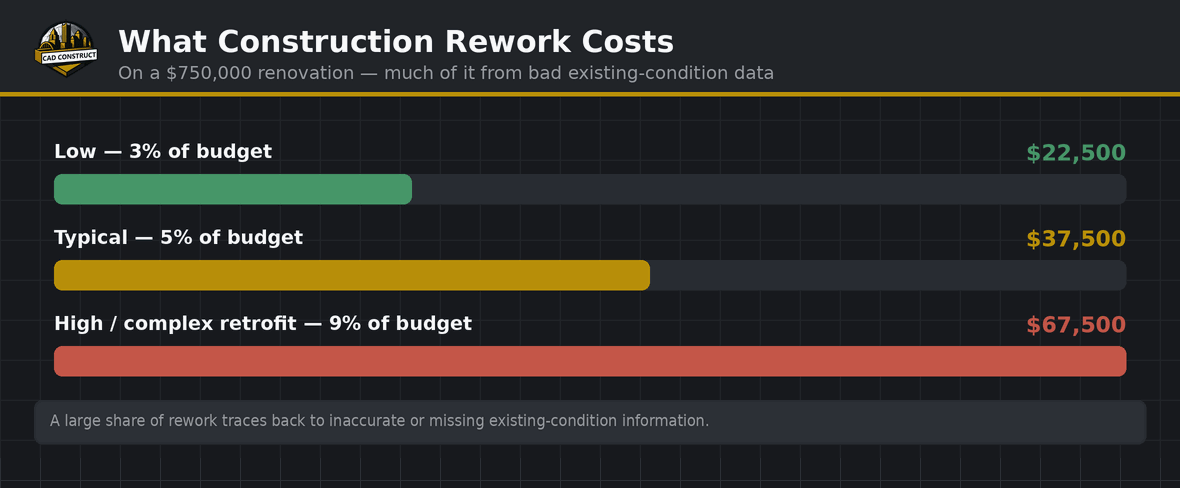
Rework — tearing out and redoing work that was built wrong — is one of construction’s biggest hidden expenses. Industry studies routinely put it in the range of 3–9% of total project cost, and a substantial portion is driven by inaccurate existing-conditions data: dimensions that were off, a duct routed through a beam that wasn’t on the drawings, steel fabricated to a plan that didn’t match the building. On a $750,000 renovation, even a 5% rework rate is $37,500 — and that’s before the schedule slips and change-order friction that come with it.
Where accurate as-builts cut the cost

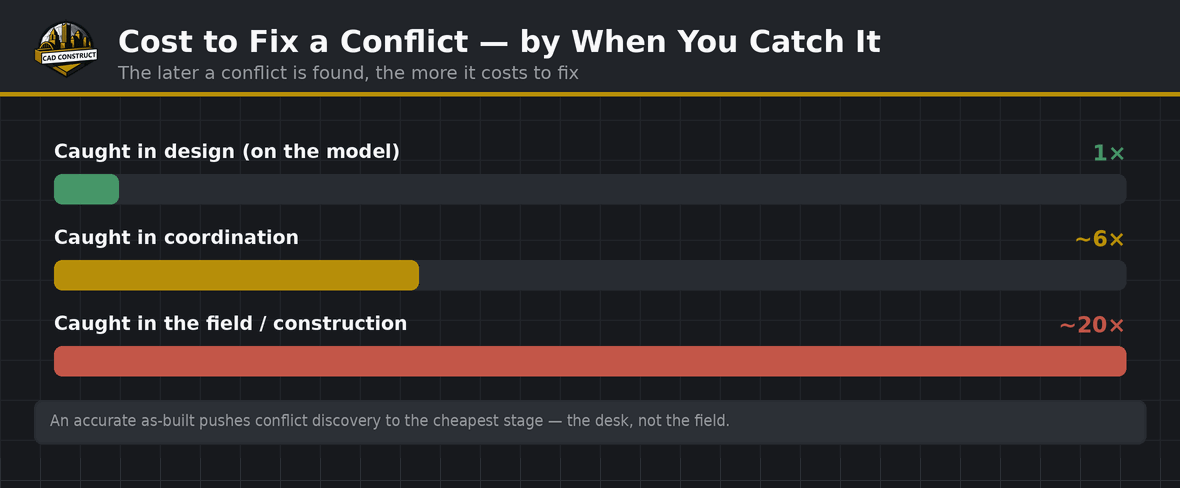
A field-verified as-built attacks rework at its source — the moment before anyone builds. Instead of discovering a conflict during construction, the design and trades coordinate against a model that matches reality. That prevents the expensive category of rework: the kind caused by bad information rather than bad workmanship. It won’t eliminate every surprise, but it removes the ones you can see coming.
The break-even math
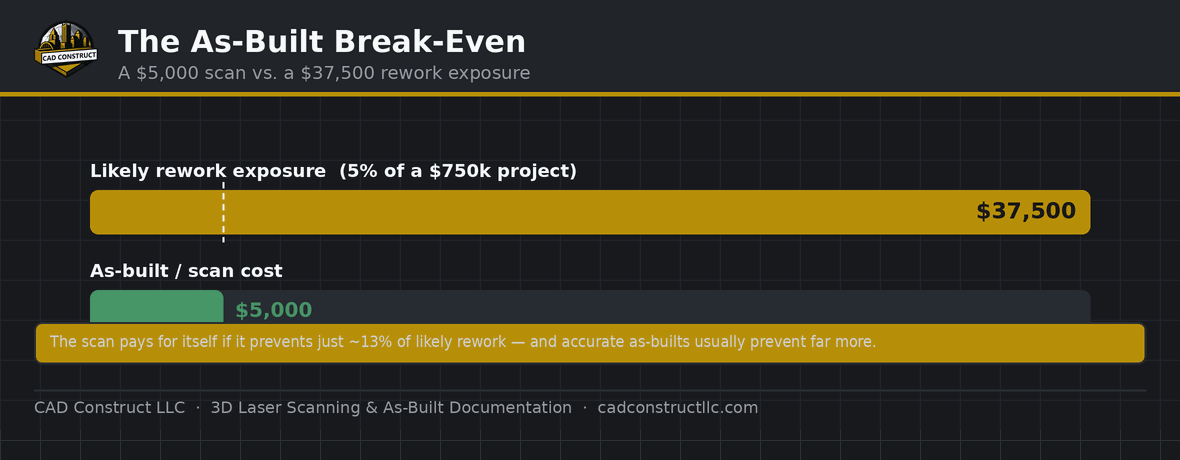
Here’s the part that makes the decision easy. Suppose a scan-based as-built for that $750,000 project costs about $5,000. Against a $37,500 rework exposure, the scan pays for itself if it prevents just ~13% of likely rework. In practice, accurate documentation typically prevents well over half of the coordination-driven kind — turning a $5,000 spend into tens of thousands in avoided cost, plus the schedule and relationship value that never shows up on an invoice.
Run your own numbers with our As-Built ROI & Rework Calculator, and estimate the scan itself with the cost estimator.
The value that isn’t in the spreadsheet

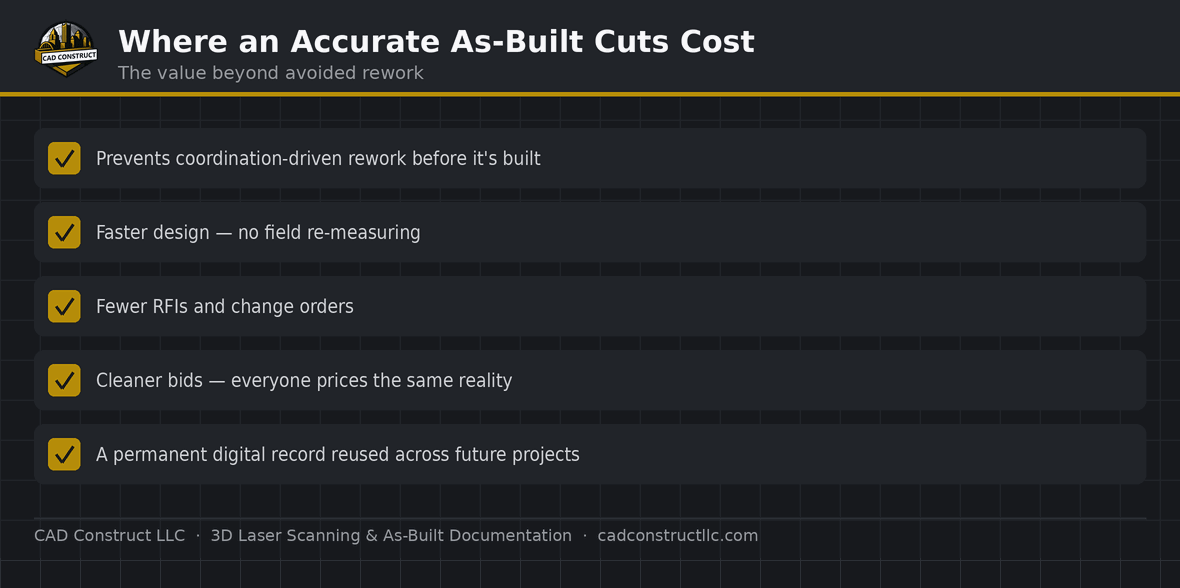
Avoided rework is the easy-to-quantify benefit. There’s more: faster design because the team isn’t field-measuring; fewer RFIs and change orders; a cleaner bid process because everyone prices the same reality; and a permanent digital record the owner keeps for future renovations and facilities work. A single as-built often serves several projects over a building’s life.
How to capture the ROI
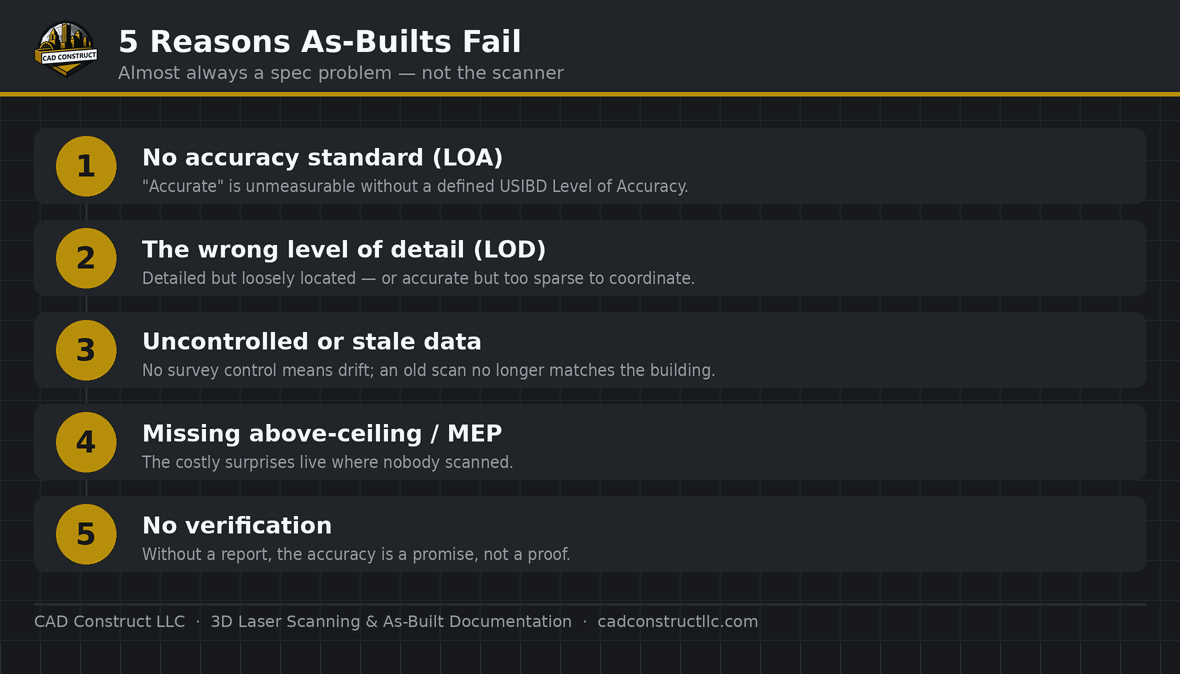
The return depends on getting an as-built you can trust. Specify a USIBD Level of Accuracy (LOA), require survey control on larger sites, and insist on a field-verification report. That’s what turns a scan from a nice-to-have into documentation your team can build from with confidence. See our scan-to-BIM and as-built documentation services, or request a quote.
Frequently asked questions

How much does construction rework typically cost?
Studies commonly put rework at 3–9% of total project cost, much of it driven by inaccurate or missing existing-condition information.
How fast does a laser scan pay for itself?

On a typical mid-size renovation, an as-built often breaks even by preventing just a single-digit percentage of likely rework — and usually prevents much more.
Isn’t scanning just an added cost?
It’s better understood as risk reduction. The relevant cost is the rework and delay that happen when the field doesn’t match the drawings.
Does an as-built help beyond one project?

Yes. It’s a permanent digital record the owner reuses for future renovations, MEP work, and facilities management.
What makes an as-built worth the investment?
A defined LOA, survey control where needed, and a verification report — so the model is accurate enough to actually build from.
Related resources
- As-Built ROI & Rework Calculator
- 3D laser scanning cost estimator
- USIBD Level of Accuracy (LOA), explained
Want the numbers for your project? Request a quote.
Free tools & templates
- 3D laser scanning cost calculator
- As-built documentation cost calculator
- Scan-to-BIM cost calculator
- 360° virtual tour cost calculator
- Virtual storefront cost calculator
- As-built ROI & rework-cost calculator
- Scan-to-BIM RFP template (Word)
- As-built scope-of-work template (Word)
- Site-prep checklist (Word)

CAD Construct LLC
3D laser scanning, as-built documentation, scan-to-BIM & 360° virtual tours across Pittsburgh & Western PA — 20+ years turning existing buildings into field-verified digital records. cadconstructllc.com


0 Comments