
Last updated:
Where physical targets meet cloud-to-cloud alignment
Key takeaways:
- Targets deliver the highest accuracy but add setup time.
- Targetless is faster, using overlapping geometry to align.
- The right choice depends on required accuracy and site conditions.
How targets and targetless (cloud-to-cloud) registration differ, and when each delivers the best accuracy.
Two ways to align scans
Target-based registration uses physical spheres or checkerboards for high, verifiable accuracy. Targetless (cloud-to-cloud) matches overlapping geometry — faster, with fewer setups. Both feed the registration step.
Which to use
High-accuracy or sparse-feature spaces favor targets; feature-rich interiors register well targetlessly. We choose based on your accuracy needs.
Stitching scans into one accurate whole
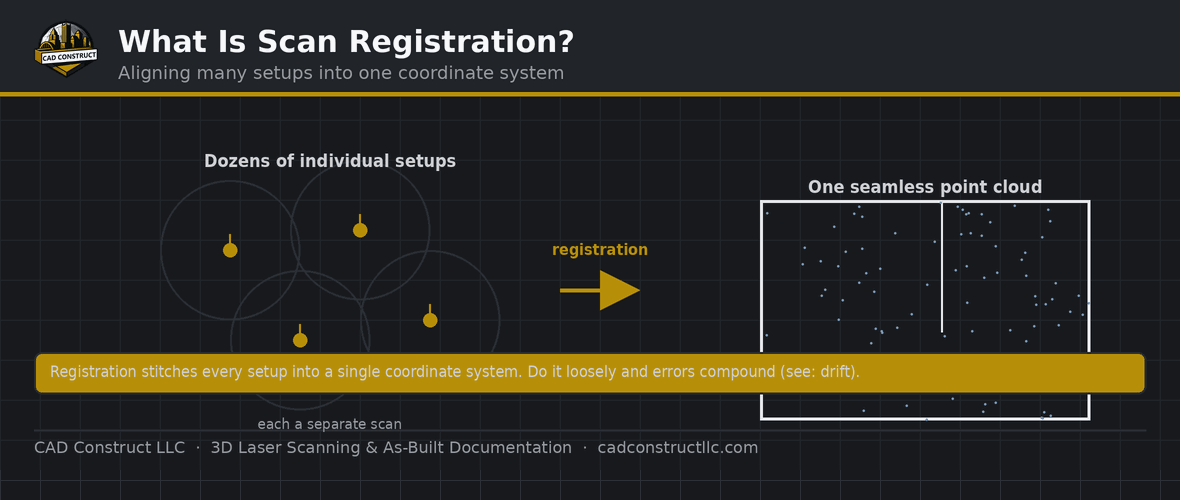
A laser scanner captures a space from many positions, and each of those individual scans must be aligned together into one unified point cloud — a process called registration. How that alignment is achieved is one of the fundamental choices in a scanning workflow, and it generally comes down to two approaches: target-based and targetless registration. Each links the separate scans in a different way, and each has strengths that suit different projects. Understanding the difference helps clients appreciate how their data is assembled and why one method might be chosen over another.
Registration is the invisible foundation of a good scan; get it right and everything built on the cloud is trustworthy, get it wrong and errors ripple through everything downstream.
What target-based registration is
Target-based registration uses physical reference markers placed throughout the scanned environment. These targets — specially designed spheres or checkerboard markers — are positioned so that each appears in multiple scans. Because the software can identify the same target across different setups, it uses those shared reference points to align the scans precisely. The targets act as fixed anchors, giving the registration reliable, unambiguous points to lock onto. This approach has long been valued for the accuracy and confidence it provides, especially on demanding projects.
What targetless registration is
Targetless registration, also called cloud-to-cloud registration, dispenses with physical markers and instead aligns scans using the geometry of the environment itself. The software recognizes overlapping features — walls, corners, and other shapes that appear in adjacent scans — and matches them to fit the scans together. As scanning technology and software have advanced, targetless registration has become increasingly capable and popular, because it removes the effort of placing and managing targets while still delivering strong results in many environments.

The case for targets
Target-based registration excels where accuracy is paramount and where the environment offers few distinctive features for geometry-based matching. In large open spaces, long corridors, or featureless areas, there may be little unique geometry for targetless registration to lock onto, and targets provide the reliable reference points that such spaces lack. Targets also offer a high degree of confidence in the alignment, which matters for projects with tight tolerances. When precision is critical or the space is geometrically ambiguous, targets remain the dependable choice.
The case for going targetless
Targetless registration shines where speed and efficiency matter and where the environment is rich in distinctive geometry. Skipping the placement and removal of targets saves considerable time on site, allowing faster capture and less disruption. In spaces full of varied features — typical interiors with walls, rooms, and objects — there is ample geometry for the software to match reliably. For many projects, targetless registration delivers excellent results with greater efficiency, which is why it has become the default approach in a growing share of work.
Combining both approaches
The choice is not always either-or. Many projects use a hybrid approach, relying primarily on targetless registration while placing targets in specific areas where extra reliability is needed — featureless spaces, critical connections, or points that tie the scan to survey control. This combination captures the efficiency of targetless registration where the environment allows while retaining the confidence of targets where they add value. An experienced team judges where each method serves best and blends them to get both speed and accuracy from a single workflow.
How registration affects accuracy
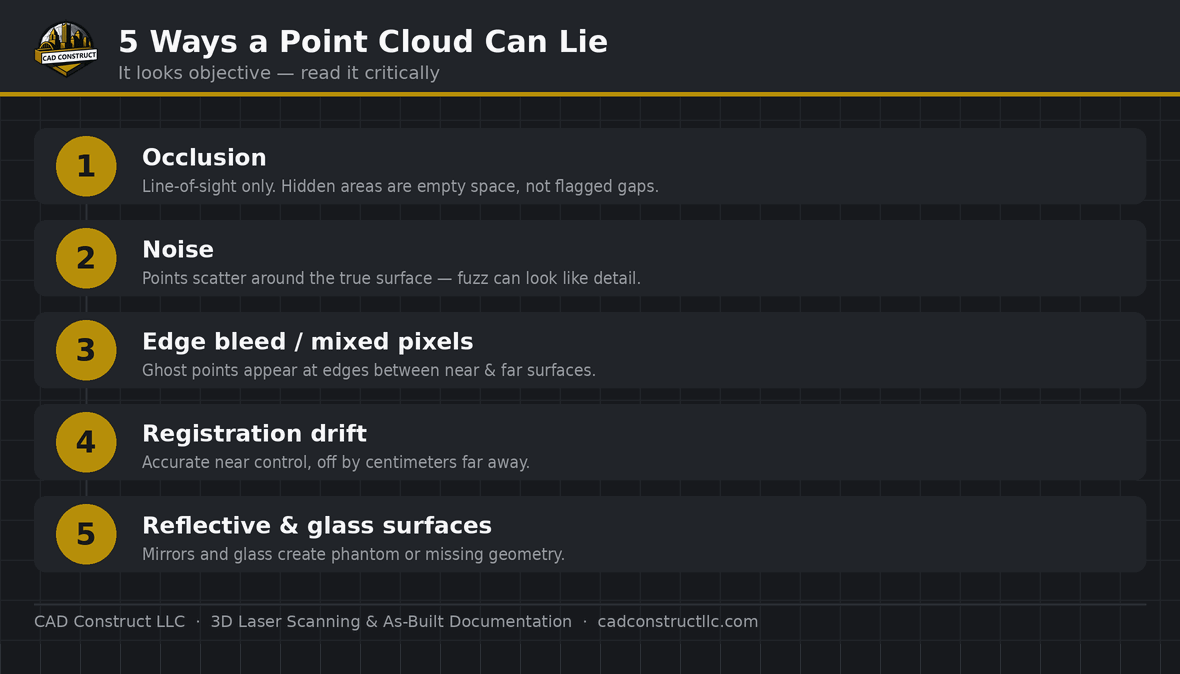
Whatever method is used, the quality of registration directly determines the accuracy of the final cloud. Poorly registered scans produce misalignments — doubled surfaces, blurred features, and dimensional errors — that undermine everything built on the data. Good registration, by contrast, yields a clean, coherent cloud that faithfully represents the space. This is why registration is not a mere formality but a critical step, and why the choice of method and the care taken in executing it matter so much to the reliability of the deliverable.
Verifying registration quality
A disciplined workflow checks the quality of registration rather than assuming it succeeded. Reviewing how well the scans align, examining overlap areas for consistency, and confirming that the assembled cloud holds together all help ensure the registration is sound. Catching a registration problem early prevents flawed data from propagating into models and analyses downstream. This verification is part of what distinguishes careful professional work, giving clients confidence that the unified cloud they receive is accurately assembled and trustworthy throughout.

How CAD Construct approaches registration
CAD Construct selects and combines registration methods to suit each project, using targets where reliability demands them and targetless techniques where they deliver efficiency without sacrificing accuracy. For clients across the Pittsburgh region, that means unified point clouds assembled with care and verified for quality — accurate, coherent data whose foundation you can trust, whatever the environment and however the scans were captured.
Time on site: the practical difference
One of the most tangible differences between the two methods is how much time they add on site. Placing targets carefully throughout a space, ensuring each appears in enough scans, and later removing them all takes real effort that grows with the size of the project. Targetless registration eliminates that overhead, letting the crew move directly from setup to setup. For projects where site time is costly — occupied buildings, active facilities, tight schedules — the efficiency of skipping targets can be a decisive advantage, shortening the visit and reducing disruption without compromising the result in feature-rich spaces.
Environments that challenge each method
Every environment plays to the strengths or weaknesses of a registration method. Long, uniform corridors and vast, empty floors offer little distinctive geometry, challenging targetless matching and favoring targets. Cluttered, detailed interiors give targetless registration plenty to work with. Reflective or repetitive surfaces can confuse geometry-based matching, while targets remain unambiguous. Recognizing how a specific environment will affect registration is part of planning a scan well, ensuring the chosen method suits the space rather than fighting against its character.
Registration and tying to control
When a scan must align to real-world coordinates or survey control, targets often play a role in tying the cloud to known points. Placing targets at surveyed locations links the scan precisely to the coordinate system, ensuring the registered cloud sits correctly in the real world. Even on projects that lean heavily targetless, a few strategically placed and surveyed targets can provide this crucial connection. This is one reason the two approaches so often work together, with targets serving the specific job of anchoring the data to external reference.

Software advances and targetless capability
The steady improvement of scanning software has greatly expanded what targetless registration can achieve. Algorithms that match overlapping geometry have grown more capable and reliable, handling environments that once would have required targets. This progress has shifted many projects toward targetless workflows, capturing their efficiency benefits with confidence. Still, technology does not erase the fundamentals: challenging environments and demanding accuracy requirements can still call for targets. Understanding both the capability and the limits of current software helps a team apply targetless registration where it genuinely works well.
Planning registration before the scan
Good registration begins with planning before the first scan is taken. Considering the environment, the accuracy required, and how the scans will overlap allows a crew to design a capture that will register cleanly, whether by placing targets thoughtfully or by ensuring sufficient geometric overlap for targetless matching. This forethought prevents the frustration of discovering, during processing, that scans do not align well. Planning the registration strategy as part of planning the capture is a hallmark of an experienced team and a key to reliable results.
Cost and efficiency considerations
The registration approach influences the overall efficiency and cost of a project. Targetless workflows can reduce field time and the associated cost, while target-based work invests more effort on site in exchange for reliability in demanding situations. The right balance depends on the project’s priorities — whether speed or maximum certainty matters more. Choosing the approach with these considerations in mind ensures the registration strategy aligns with the project’s goals, delivering the needed accuracy at a sensible cost rather than defaulting to one method regardless of fit.
Why the method matters to clients
Clients rarely need to manage registration themselves, but understanding it helps them appreciate what goes into a quality deliverable and why an experienced provider matters. The choice between target-based and targetless registration, and the skill in executing it, directly shape the accuracy and reliability of the data they receive. Knowing that this foundational step has been planned and verified with care gives clients confidence in the result. It is a reminder that a good scan is not just about the moment of capture but about the craft of assembling that capture into trustworthy data.
The foundation beneath the data
Registration is ultimately the foundation on which everything else in a scan rests. Whether achieved with targets, without them, or through a blend of both, its purpose is the same: to unite many individual scans into one accurate, coherent representation of reality. When that foundation is solid, the models, drawings, and analyses built on it can be trusted. Appreciating the role of registration — and the thought that goes into choosing the right approach — reveals why careful, professional scanning produces data that is dependable from the ground up.
Related reading
3D Laser Scanning vs. Photogrammetry vs. Drones: Which Is Right for Your Project?
Point Cloud File Formats Explained: RCP, E57, LAS, PTS and More
What Is a Point Cloud? A Beginner’s Guide
What Is LiDAR? A Plain-English Guide
Georeferencing & Coordinate Systems in Laser Scanning
What Is Autodesk ReCap? A Beginner’s Guide
· How Accurate Is 3D Laser Scanning?
FAQ
Which is more accurate? Target-based is easiest to verify; targetless is highly accurate in feature-rich spaces.
Do I need to choose? No — we select the method for your project.
Get field-verified existing conditions in Pittsburgh
CAD Construct LLC delivers 3D laser scanning, as-built drawings, scan-to-BIM, and 360° virtual tours across Pittsburgh & Western PA. Request a free quote or call (800) 967-2627.


0 Comments